
Beyond the Cognitive: The InteMind Method® and the Four Levels of Transformation
June 30, 2025
In the fields of psychotherapy, counselling and coaching, a growing number of practitioners are recognising a critical truth: insight alone is not enough. While cognitive and behavioural models offer tools for managing thought patterns and increasing awareness, many clients report that understanding their problems doesn’t necessarily help them feel or live differently.
The InteMind Method® was developed in response to this gap.
It offers a client-centred, four-level framework that goes beyond cognition to support deep, whole-person transformation—engaging not only thoughts and behaviours but also emotions, intuition, identity, and the spiritual dimension of healing.
A Need for Deeper Integration
Many therapeutic approaches stop at the narrative level—helping clients reframe their experiences or shift their mindset. These interventions can be useful, particularly for those navigating anxiety, stress, or limiting beliefs. However, they often leave clients returning to the same patterns after the initial insight fades.
Alternatively, those seeking deeper meaning or spiritual connection may turn to more traditional Eastern philosophies, spiritual schools, or transpersonal therapy. But such paths can feel rigid or misaligned, especially for clients who don’t resonate with prescribed frameworks or specific belief systems.
The InteMind Method® bridges these worlds.
It honours the complexity of being human—offering a grounded yet expansive path that helps individuals explore their own definitions of meaning, wholeness, and connection.
The Four Levels of Transformation
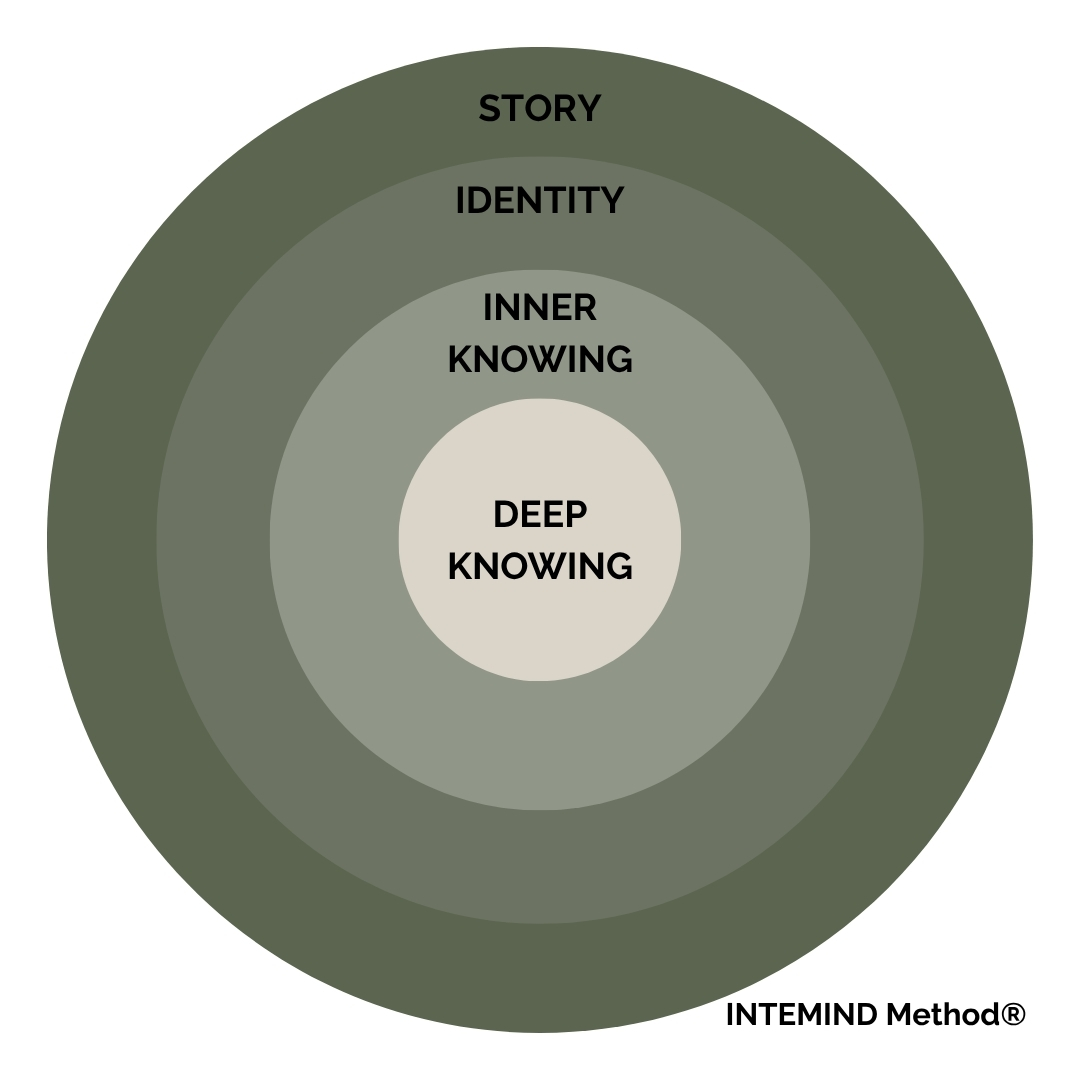
At the core of the InteMind Method® are four levels of client experience. These are not linear stages but fluid layers through which clients may move in and out, depending on readiness, integration, and individual circumstance.
1. Story: “What’s the story I’ve been living?”
This level explores the client’s life narrative—their experiences, memories, wounds, and perceptions. It includes both the external events and the internal meaning the client has made from them. At this stage, practitioners build rapport and use emotional expression as a diagnostic and relational tool.
Clients may remain in this space for some time, especially if they are navigating trauma or grief. Research has shown that storytelling can be central to trauma integration and identity formation (Pals, 2006), yet story alone doesn’t create transformation—it opens the door.
2. Identity: “Who have I become because of my story?”
This level focuses on the psychological constructs that have formed as a result of the narrative: belief systems, identity roles, defence mechanisms, behavioural patterns, and survival strategies.
Here, practitioners support clients in exploring internalised narratives, challenging limiting beliefs, and recognising emotional and psychological triggers. At the same time, clients begin to uncover their strengths and reconnect with values and desires that may have been buried or forgotten. This aligns with existing research on post-traumatic growth and meaning-making (Tedeschi & Calhoun, 2004).
3. Inner Knowing: “Who am I beyond my story?”
In this more intuitive space, clients begin accessing what many describe as the “observer self”—a calm internal presence that recognises thought and behaviour without being defined by it. This level often brings clients into contact with what is sometimes described as the “authentic self” or core consciousness (Welwood, 2000).
This can be a delicate phase. Clients may feel fear, disorientation, or resistance as they let go of familiar identity structures. Others may experience moments of stillness, clarity, or what Newberg (2009) calls “enlightenment with a small ‘e’”—subtle but transformative shifts in awareness. Practitioners are trained to hold this space with sensitivity, avoiding the impulse to interpret or label the client’s experience.
4. Deep Knowing: “What am I connected to beyond myself?”
The final level involves connection to something greater—whether the client names this as spirit, soul, source, nature, or simply a felt sense of belonging within the greater web of life. This stage often includes existential meaning-making, deep peace, and emotional-spiritual integration.
Newberg and Waldman (2009) describe this as a moment of “big E” Enlightenment, in which individuals experience a profound sense of unity or sacred connection that can radically shift their relationship to life. However, within the InteMind Method®, this level is not something practitioners strive to induce—it is something that arises naturally, in the right conditions, through the client’s own readiness and journey.
Client-Centred and Non-Dogmatic

What sets the InteMind Method® apart is its refusal to impose a specific spiritual narrative. Instead, it invites clients to discover their own experience of inner and deep knowing. In doing so, it avoids the potential for spiritual bypassing—where difficult psychological material is overridden by premature transcendence (Masters, 2010)—and encourages clients to be present with both their humanity and their wholeness.
Rather than teaching people to detach from pain, the method promotes immersion—supporting clients to feel and integrate difficult emotions while also holding the possibility of something beyond them. It encourages grounded spirituality rooted in personal truth and lived experience.
Training and Application
The InteMind Method® is currently taught at two institutions:
✔️ The Australian School of Holistic Counselling (ASHC)
✔️ Intemind International (UK)
The InteMind Method® is used in therapeutic settings, coaching, trauma-informed care, and integrative wellness programs. Students and practitioners are trained to work across all four levels of awareness, developing the skills to guide clients through these processes without relying on scripts or fixed interventions.
The model supports fluid movement between emotional, cognitive, intuitive, and spiritual states, allowing practitioners to respond to the full scope of a client’s transformation process.
Conclusion
The InteMind Method® offers a needed evolution in the way we approach healing and personal growth. By integrating narrative, identity, intuition, and connection, it creates space for deep, meaningful transformation—without bypass, dogma, or detachment.
In a world saturated with surface-level solutions and quick-fix mindsets, the InteMind Method® reminds us that healing is layered, personal, and sacred.
References
Masters, R. A. (2010). Spiritual bypassing: When spirituality disconnects us from what really matters. North Atlantic Books.
Newberg, A., & Waldman, M. R. (2009). How God changes your brain: Breakthrough findings from a leading neuroscientist. Ballantine Books.
Pals, J. L. (2006). Narrative identity processing of difficult life experiences: Pathways of personality development and positive self-transformation in adulthood. Journal of Personality, 74(4), 1079–1110. https://doi.org/10.1111/j.1467-6494.2006.00403.x
Tedeschi, R. G., & Calhoun, L. G. (2004). Posttraumatic growth: Conceptual foundations and empirical evidence. Psychological Inquiry, 15(1), 1–18. https://doi.org/10.1207/s15327965pli1501_01
Welwood, J. (2000). Toward a psychology of awakening: Buddhism, psychotherapy, and the path of personal and spiritual transformation. Shambhala.